




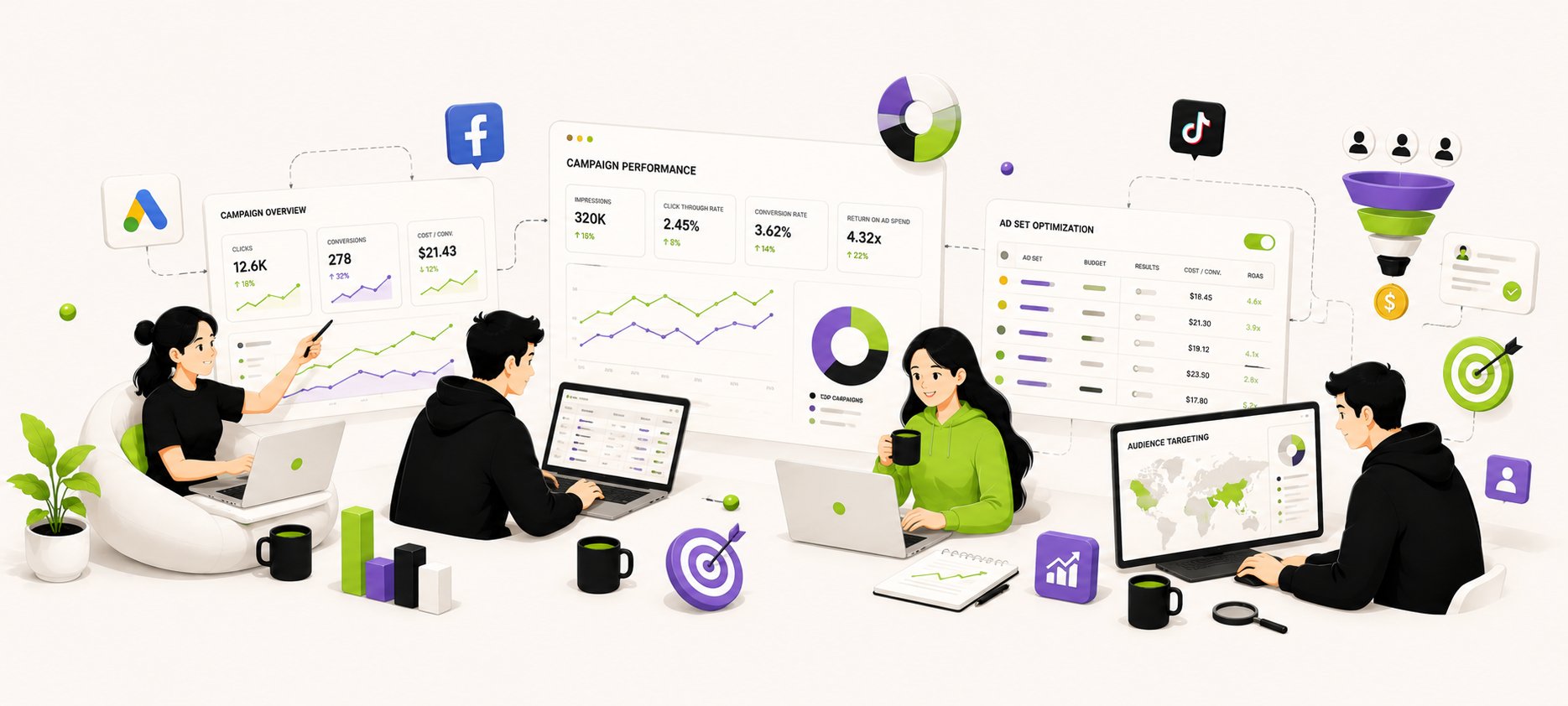


The real cost of random marketing almost never shows up on the media spend invoice. It's in the budget spent on campaigns that don't build on each other. It's the momentum lost every time a business stops and restarts its marketing. And it's the opportunity cost of leads that were never followed up, simply because there was no system behind the activity. When marketing turns into a series of one-off pushes, a boosted post here, a promo there, an SEO sprint that fizzles out, the real bill arrives months later, in flat growth and a brand that never quite compounds.
01What "Random Marketing" Really Costs You
The real cost of random marketing almost never shows up on the media spend invoice. It's in the budget spent on campaigns that don't build on each other. It's the momentum lost every time a business stops and restarts its marketing. And it's the opportunity cost of leads that were never followed up, simply because there was no system behind the activity. When marketing turns into a series of one-off pushes, a boosted post here, a promo there, an SEO sprint that fizzles out, the real bill arrives months later, in flat growth and a brand that never quite compounds.
This pattern is especially common among Malaysian SMEs. A business tries a Facebook ad, sees a small bump, pauses when results plateau, tries something else, and repeats. Each attempt gets judged on its own instead of as part of a system. That's exactly how the true cost of random marketing stays hidden, until someone finally sits down and adds it all up.
02Where the Hidden Costs Add Up
Random marketing rarely fails loudly. It fails quietly, in a handful of ways that repeat themselves:
None of this shows up as a line item. That's exactly why it's so easy to underestimate, and why the true cost of random marketing tends to run far higher than the ad spend alone suggests.
- Wasted ad spend: Campaigns launched without a clear audience or offer strategy burn budget on the wrong people, or on the right people at the wrong stage of their buying journey.
- Stop-start cycles: Every time a campaign pauses and a new one starts from scratch, the learning, the creative testing, and the audience data that had built up get thrown away instead of carried forward.
- No owned assets: Ad-only activity with nothing behind it in SEO, content, or audience-building means the business is renting attention every month rather than building something that keeps working on its own.
- Inconsistent brand signals: Messaging, offers, and creative direction that keep changing confuse the audience and make it harder for any single effort to build trust.
- Internal time cost: Business owners and staff spend hours briefing, reviewing, and correcting course on marketing that has no strategy anchoring it, time that rarely gets counted as part of the campaign's real cost.
03Why Strategy Costs Less Than It Looks
A structured approach can look more expensive at the outset, because it involves planning rather than just launching. But strategy is what lets one campaign build on the last. Audience data carries over. Creative learnings inform the next test. SEO and content work keep compounding instead of resetting to zero. It's the core idea behind Edge Point Solutions: marketing should drive measurable business growth rather than vanity metrics. In practice that means combining strategy, creative content, paid advertising, SEO, and AI-powered automation into one system, rather than treating each channel as a separate bet.
Continuity matters more than any single tactic. A business that sticks with one coherent plan for months will typically outperform a business that switches direction every few weeks, even when total spend is about the same. The related article The True Cost of Random Marketing goes deeper into how marketing budget, continuity, and owned assets interact. It's worth reading alongside this piece if you're trying to work out where your own spend is leaking.
04How to Audit Your Own Marketing Costs
Before adding more budget or trying another channel, it helps to step back and ask a few honest questions.
If the honest answer to most of these is no, the issue usually isn't the channel. It's the absence of a plan connecting it to everything else. The article Why Most Marketing Plans Fail Before They Start covers a related root cause worth checking alongside this audit. It's also worth reviewing how the pieces are meant to fit together in the first place. See Our Services: How Edge Point Solutions Helps You Advertise Smarter for how strategy, paid ads, SEO, and content typically get combined into one system.
- Is there a written strategy behind current campaigns, or is activity being decided week to week?
- Are leads being captured and followed up consistently, or are they getting lost between channels and tools?
- Is any of this spend building an owned asset, a content library, an audience list, search rankings, or does it disappear the moment spend stops?
- Would a competitor have to spend more to catch up to what's been built, or could they replicate it in a single campaign?
05FAQ
06What is "random marketing"?
Random marketing describes disconnected, reactive marketing activity: ads, posts, or promotions launched without a shared strategy, where each effort is judged and run on its own instead of building on what came before.
07Why does random marketing end up costing more?
Because the losses are hidden in wasted spend, in learning curves that keep restarting, and in time spent managing activity with no clear direction. None of that shows up as an obvious extra line on any single invoice.
08Is random marketing only a paid advertising problem?
No. It affects SEO and content just as much. Sporadic, inconsistent effort in either area rarely compounds into the rankings, traffic, or brand recognition that sustained, strategic effort produces.
09How do I know if my marketing is "random"?
If campaigns are planned week to week rather than against a documented strategy, and past results aren't informing future decisions, that's a strong sign the current approach is more reactive than strategic.
10Talk to Edge Point Solutions
If you suspect random marketing is quietly costing your business more than it should, Edge Point Solutions can help you look at what's actually happening across your campaigns, and where a more connected strategy would pay off. Reach out through the Edge Point Solutions website to start that conversation, or read the Frequently Asked Questions About Edge Point Solutions page for more on how the team works.
- 01The real cost of random marketing almost never shows up on the media spend invoice.
- 02Random marketing rarely fails loudly.
- 03A structured approach can look more expensive at the outset, because it involves planning rather than just launching.
- 04Before adding more budget or trying another channel, it helps to step back and ask a few honest questions.